Data from OFV, the Norwegian Road Federation, shows Chinese brands took 18% of Norway's new-car market in September 2026 and 18.2% year to date, up from 12.9% and 13.0% at the same point in 2025; among private buyers the share is 19.4%. OFV also analysed 11,626 private buyers of a new Chinese-brand car who had a previously registered car, to see which brand they came from.
Where the buyers come from
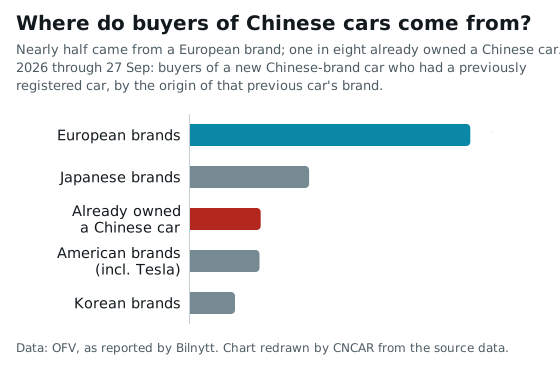
Of those buyers, 48.0% previously drove a European brand, 20.4% a Japanese brand, 11.9% an American brand (Tesla included) and 7.7% a Korean brand. Another 12.1% (1,401 buyers) already owned a Chinese car — about one in eight.
Which brands, specifically
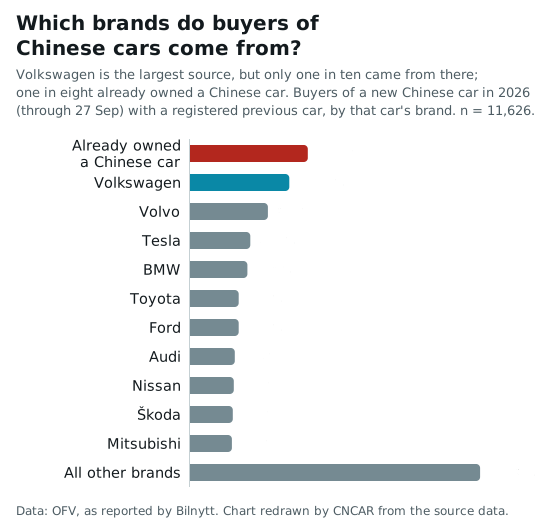
Broken down by the brand of the previous car, Volkswagen is the largest single source, but at just 10.2%. Volvo follows (8.0%), then Tesla (6.2%) and BMW (5.9%), with Toyota and Ford at 5.0% each. The top of the list is mostly brands that already sell the most in Norway, which suggests Chinese brands' growth is coming from the mainstream installed base rather than a niche.
Who loses the most
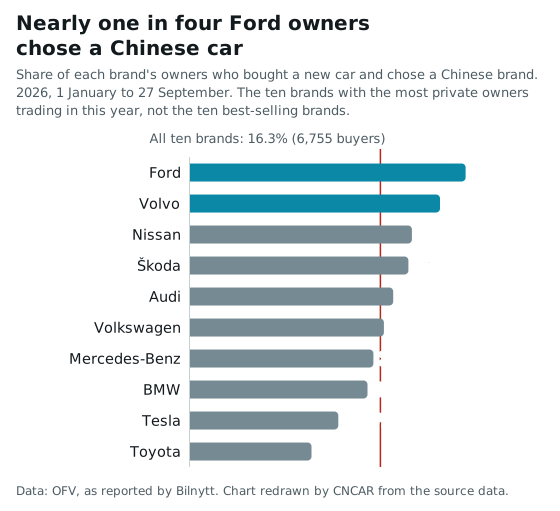
The other angle is where each brand's owners go. Among owners who bought a new car this year, Ford has the highest share choosing a Chinese brand at 23.6% (13.7% in 2025), followed by Volvo at 21.4% (15.3% in 2025), Nissan at 19.0% and Škoda at 18.7%; across all ten brands the figure is 16.3% (6,755 buyers). Note that these ten are the brands with the most private owners trading in this year, not the ten best-selling brands.
Tesla owners are far more loyal than any other brand's: of Tesla owners buying a new car this year, 72.8% chose another Tesla, although the share choosing a Chinese brand rose to 12.7% from 7.5% across 2025. Tesla is also winning customers from European brands: 22.3% of Volkswagen owners buying new this year went to Tesla, and 22.1% of Audi owners.
Buyer profiles and regional differences
Buyer profiles differ a lot between Chinese brands. The average age across all brands is 52.1; Changan (54.0) and BYD (53.7) buyers are the oldest, XPeng and NIO buyers the youngest (45.8), and Tesla buyers average 42.5. Zeekr buyers previously owned a car with an average price of NOK 525,799, JAC buyers NOK 330,940, and more than half of JAC's and Dongfeng's buyers are women. Regionally, this year's Chinese-car purchases come to 3.36 per 1,000 residents in Telemark against 1.06 in Finnmark.
How to read these numbers
Start with the definition. As reported by Bilnytt, OFV counts BYD, Changan, Chery, Dongfeng, Exlantix, Hongqi, JAC, Leapmotor, Lotus, Maxus, MG, NIO, Omoda, Polestar, Seres, Voyah, XPeng and Zeekr as Chinese brands; Volvo and Smart are not included. That is not the definition behind the 25% in our earlier article (Yrkesbil's ownership-based count, which includes Volvo and Smart, for the EV market in January–July), nor the 7.1% for BYD and XPeng alone in September on the sales ranking page. Each answers a different question, so they can't be compared or subtracted directly.
What this means for Chinese brands
First, the real competitors are the mainstream European brands. Nearly half of Chinese-brand buyers came from a European brand, and mainstream and upper-mainstream names like Ford, Volvo and Volkswagen are the easiest to move; Tesla is also drawing from the same European owners, so the two are fishing in the same pool.
Second, Tesla owners are still the hardest to win, but not a closed door: 72.8% repurchase, yet 12.7% have already moved to a Chinese brand, well above the 7.5% of 2025.
Third, the repeat-purchase base is only just forming. With just 12.1% of buyers already owning a Chinese car, the ownership and service experience of that first wave of owners will decide over the next few years whether the share grows — which makes the service network and warranty (see Norway's consumer warranty law and the dealer-group map) not just a cost line but a precondition for repeat sales.
Fourth, "Chinese brands" is not one segment. Buyer ages span more than eight years, and previous-car price, gender mix and regional demand all differ, so positioning and network planning should be done brand by brand, not against a "Chinese-brand average." This is a snapshot of the first three quarters of 2026, not a trend forecast. Meanwhile the number of brands on sale in Norway has risen from 38 in 2017 to 64 in 2026, up 68%.
Sources (Norwegian): OFV press release, "Tesla holder på kundene"; Bilnytt, "Disse bilmerkene mister kunder til kinesiske bilmerker" (may require a subscription). Chart data is OFV's, redrawn by CNCAR from the source numbers.